
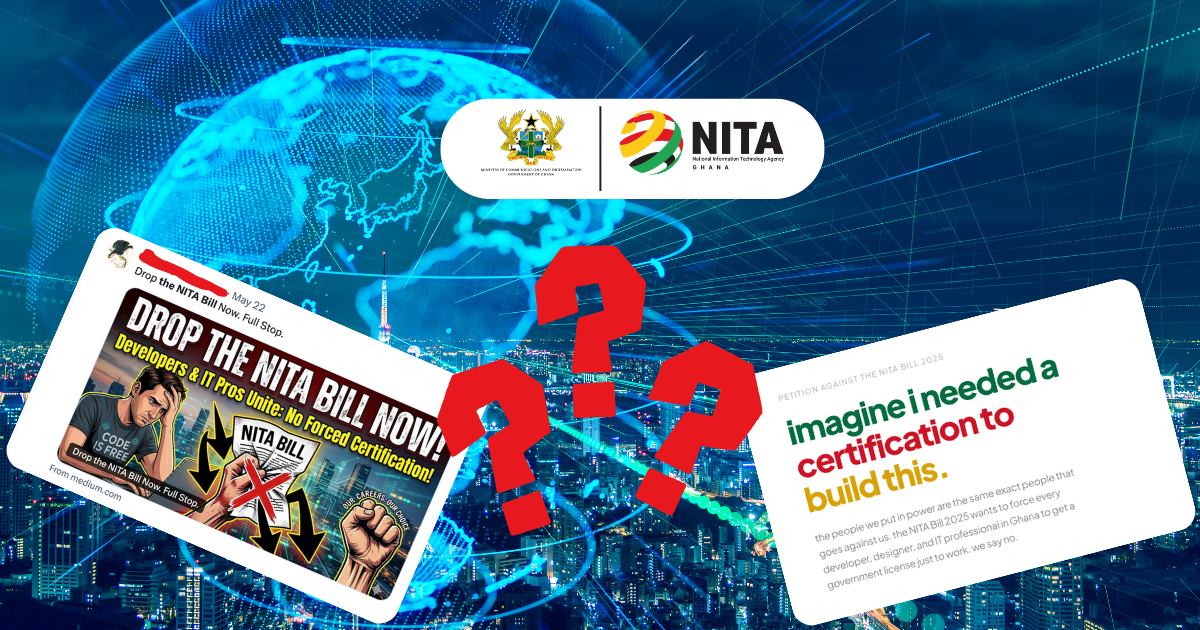
A license to build: what Ghana's NITA Bill gets wrong
A plain-English guide to the law every Ghanaian in tech is arguing about, and what it means for you.
It is in every developer chat right now. The NITA Bill. People are furious, the word "coup" keeps flying around, and here is the strange part: almost nobody shouting about it can tell you what is actually inside.
So let me do that first. Plainly, and from the start.
NITA stands for the National Information Technology Agency. It is the government body that has quietly run Ghana's public tech systems since 2008. Think of the parts of government you touch online: the official websites, the .gov.gh addresses, the government data centres, the portal where you pay for a passport. That is NITA's work, mostly behind the scenes.
The NITA Bill is a draft of a new law. A bill is a proposed law that has not been passed yet. This particular draft would hand NITA something it has never had before: real power over people and businesses. The power to decide three things.
Who is allowed to run a tech company in Ghana.
Who is allowed to be hired to do tech work.
What each of them must pay for the permission.
That third point is the spark. People sat down, read the draft, and did not like what they found. One widely shared article branded the wider package a "Cyber Coup d'État." The think tank IMANI Africa warned that Ghana was building a "digital iron curtain," a wall around its own internet. A petition called "Stop the NITA Bill" filled up with angry comments. NITA hit back in May 2026, calling the coup talk a set of "misconceptions."
So who is right? That is exactly what you should be able to judge for yourself by the end of this. Because if this passes the way it reads today, it changes the rules for everyone near tech in Ghana. The self-taught coder. The two-person startup. The freelance designer working from a bedroom in Tamale. Five minutes now is cheaper than finding out the hard way later.
What the bill actually says
Start with one word, because it carries the whole story.
The 2008 law created an Agency. This new draft turns it into an Authority. An agency mostly provides services. An authority licenses, polices, fines, and shuts things down. That single upgrade is the difference between a helper and a gatekeeper.
Here is what the draft would do, in plain terms:
You would need a license to operate. A license is official permission from the state. Under the draft, running cloud hosting, a data centre, or a serious software product without one becomes illegal.
Section 37: Ghanaians only. A licensed company must be owned 100 percent by Ghanaians. One foreign shareholder, and on a strict reading, you no longer qualify.
Section 46: certified, or you do not work. The draft says, in its own words, that "a person shall not be appointed as an ICT professional in a public or private institution unless that person is certified by the Authority." A certificate here is a government stamp saying you are qualified. No stamp, no job.
Section 31: one company gets the keys. A single state-owned firm would be handed the government's digital work, the kind of contracts private companies compete for today.
The fines are brutal. For serious failures handling people's data, penalties reach 10 percent of a company's annual turnover. Turnover is every cedi a business takes in before costs. Not profit. The whole top line.
To be fair to NITA, it has a real argument. The Minister in charge, Sam George, says the old setup left gaps in "data security, privacy, economic inclusion, intellectual property rights and digital sovereignty." NITA points out that Ghana's tech sector is worth about a billion dollars today and could reach five billion by 2030, and asks a fair question: how can an industry that size run on a law written in 2008?
It cannot. Growth needs rules. But there is a difference between rules that guide an industry and rules that strangle it. Section 46 is where the draft crosses that line.
The world already chose proof over paper
Picture a 22-year-old in Kumasi who taught herself to code on a secondhand laptop. She has built three apps. One of them works well enough that a startup in Lagos wants to hire her.
Today, that hire is simple. The manager opens her app, runs it, sees that it works, and makes an offer. Under Section 46, that same manager has to stop and ask a new question first: does she have a NITA certificate? If not, the offer cannot stand. The thing she can actually do stops counting until the government agrees she is allowed to do it.
Now ask yourself: when did a certificate ever build a working app?
Because the entire global tech industry has spent the last decade answering that question, and the answer was clear. Hiring moved from proof of paper to proof of work. From what you hold, to what you have built and can show. Look at where the biggest names landed:
Google built its own short career certificates and announced it would treat them as equal to a four-year university degree for related roles. The paper was never the point. The skill was.
IBM created a whole class of roles it calls "new collar" jobs, hiring on skill instead of degree, because too many capable people were being filtered out by qualifications they never needed.
GitHub became the real resume for coders. It is a public website where developers store their work in the open, so anyone can see exactly what they have built. Recruiters open it before they open your CV.
Zindi and Kaggle did the same for data scientists. On these sites you compete to solve real problems in public, and your rank is decided by how well you actually solve them, not by a course you sat through.
See the pattern? The market stopped trusting the certificate as a stand-in and started asking to see the work itself. Section 46 marches in the opposite direction. It drags the certificate back to the front gate, makes it compulsory, and hands the government the only key. A young Ghanaian could have ten finished products and a paying client in Berlin, and still be told she is not a real professional at home.
Who actually gets hurt
Not the big firms. A multinational shrugs off a license fee and hires a compliance team to handle the paperwork. The people who cannot shrug it off are the exact ones Ghana keeps saying it wants more of.
Take two of them:
The self-taught learner. The whole promise of tech for a young African is that you can rise without permission. No rich family. No foreign degree. Just a laptop, some electricity, and the discipline to finish things. Section 46 quietly adds a new item to that list: a government stamp. For someone already fighting for data and power and time, that is one more wall to climb.
The startup. Section 37 reads like patriotism and works like a cage. Serious African startups survive by raising money across borders. The moment a Nigerian fund buys a slice, or a Kenyan co-founder owns part of the company, that business can no longer hold the license it needs. Ghana hosts the headquarters of the African free trade area and preaches one open African market at every summit. What does it say when its own law locks out the rest of Africa?
There is a money worry too. Critics read the bill's funding section as a 1 percent charge on the gross revenue of every tech business in the country. NITA disputes that reading. The honest problem is that the wording is loose enough for both sides to claim it, and a draft this serious should not be this easy to argue about.
What you can do right now
You cannot control whether this bill passes. You can control how ready you are for a world that, law or not, increasingly wants proof before it trusts paper. These moves pay off either way:
Build in public. Put your work where anyone can find it. GitHub for code, a simple one-page site for everything else. Work that someone can open and run convinces for you while you sleep.
Keep your receipts. Hold a running folder of what you have shipped. A link, a screenshot, one line on the problem you solved. In a real interview, that beats a drawer full of certificates.
Contribute to open source. Open source is code shared publicly for anyone to use and improve. Fix small things in projects people rely on, and strangers, including foreign employers, start vouching for your skill in the open.
Earn across borders early. A remote role or a client in another country puts your reputation beyond the reach of any single regulator at home.
And do one civic thing. Read the actual draft, not just the hot takes about it. NITA is still accepting written comments, and a clause changes when enough people who understand it push back in writing. Five clear minutes from someone who builds is worth more than a hundred angry posts.
The market has already decided what counts. Not the certificate you hold, but the thing you built that someone else can open, run, and judge for themselves. Build it. Show it. Then watch any law try to pretend you do not exist.
Share
Share
/ written by

Godson Antwi
Founder, Build_it
The Build_it Editorial team writes about completion, consistency, and the outcomes that make learning worth finishing. Field-tested, hiring-manager approved, zero growth-hack clickbait.